Ben Hjertmann
Music Composition, Teaching, Recording, Instrument Building
Empaths
The Empath instruments are my original invented instruments which use "Empath Bridges" to actuate the strings.
Empath I was designed as a commission for Elliot Cole, who requested a second instrument with sympathetic strings for his Raga-Guitar in 2023. After years of trial and error, I created the Empath I (2023-2025), a 24-string instrument with flexible diatonic scale tunings that can function as sympathetic strings, but with many other capabilities.
Then in 2026, I created Empath II, a 72-string instrument designed to be played by a MIDI keyboard and/or microphone. This instrument premiered as an interactive installation at {Re}HAPPENING 2026, presented by Black Mountain College Museum and Arts Center. Lots more info below!
Photos of Empath II from {Re}HAPPENING 14 (2026)

Photo by Blue Rodgers, copyright 2026, used with permission.

Photo by Bryan Swagerty, copyright 2026, used with permission.

Photo by BMCMAC Staff, copyright 2026, used with permission.

Photo by Blue Rodgers, copyright 2026, used with permission.
Empath I


Empath II


Sympathy vs. Empathy
This concept is an analogy and gives a memorable name for the instrument. As I understand these terms in psychology, sympathy means "I feel for you," whereas empathy means "I feel with you." There is a distance with sympathy and more of an intertwining with empathy.
While, of course, strings can not feel in way humans do, this analogy does at least point to the subtle but important difference between sympathetic strings which we hear, for example on a sitar, and the empath bridge system. Sympathetic strings are those which are attached to the same instrument body as their source, usually running under the played strings or fretboard. When a played string shares one or more harmonics (modes of vibration) with a sympathetic string, it is excited and vibrates in one of its vibrational modes for the shared harmonic(s). It can't help it.
The same phenomenon can occur from a separate instrument or resonating body that we will call sympathetic resonance. For example, the strings inside a piano, when someone depresses the sustain pedal, with resonate sympathetically when other strings are played or when a person yells or sings into it. Only the shared harmonics resonate. In the case of most pianos, which are not tuned to Just Intonation, the harmonics may be activated by pitches that are close enough to excite their harmonics. Maybe you've played a loud distorted guitar and when you stopped you heard an acoustic guitar across the room ringing. Or that pesky snare drum buzzing when you play bass? Sympathies.
In these cases, the sympathetic strings/resonators can only be actuated or not by the source, and once they are, they simply ring out. The empath bridge system described below has more direct control/interaction with the strings so that if the shared harmonic in the source stops, the strings stop too. The empath bridge starts and stops the strings and allows for changing pitches quickly.
Sympathetic strings are actuated by the source (usually other played strings) creating a feedback loop which extends the resonance. In contrast, the Empath instruments work passively with the audio source so that it actuates the strings without feeding into the soundboard. The pickups can send the string-only signal to an amp without a feedback loop.
Empath Bridge
The empath bridge is my original invention for this instrument. I want to be sure to give credit also to Elliot Cole for the initial inspiring idea of a standalone sympathetic string box and connecting me with Jeff Snyder, who I ran the initial idea by. He makes amazing instruments as well!
More specifically, it is a repurposing of a device known as an exciter/driver/transducer. It seems the world hasn't really settled on what to call these. They are essentially speakers with no cone. In other words, they are the heavier driving element that moves the lighter cone (often cardboard/paper) in a traditional speaker.
They are often used for custom projects like embedding a vibrating element in a theater or amusement park ride's seat or headrest. Or, they are used to create speakers out of anything. The gut immediately goes to something like a table or window, however, the best surfaces to try that I've found are lampshades and large sheets of card stock paper. That makes sense, they are actually a lot like normal speaker cones.
The empath bridge uses this device in an unusual way. If I just slapped the exciter on the bridge of a guitar, it would make some a decent speaker with some string resonance. Instead, the exciter drives the bridge laterally (you could say it shakes the strings back and forth). Furthermore the bridge is woven between each string so that it both stops the strings and only vibrates them and not the body of the instrument. If it did vibrate the body, it would again become a low quality speaker and create a feedback loop with the strings. Granted, this would still work but would not be as unique a sonic situation.
You are welcome to give my invention a try. I will say that the initial idea of using an exciter as a bridge happened years before I was finally able to dial in all the elements. You can get some activity easily, but to really get this thing singing, you have to balance a lot of elements.
Weaving the Bridges
After much experimentation, I finally settled on fully-woven empath bridges on the actuator side and fixed bridges on the pickup side.
The empath bridges are threaded steel rods which act like a nut cradling the string rather than allowing it to jiggle side-to-side. They are woven between the strings, alternating over/under the strings. On both empaths, there are two empath bridges splitting the instrument width in half. This is preferred over one long rod since the exciters are less able to actuate the strings farthest from them. The two halves are fed audio from the left and right channels which can be controlled specifically in their range or simply fed the same mono signal or stereo mix.
The woven bridges actuate the strings beautifully with free motion in any direction, un-tethered to the instrument body. This allows for direction conduction of vibrations from the audio source to the strings, with little loss to another object. Attaching or even lightly holding the empath bridges to the instrument body, rather than weaving them through the strings, conducts the vibrations directly into the body as well, creating the feedback loop previously mentioned. So the empath bridges are held by the alternating pressure of the strings only. On Empath II, I also counter-wove solid steel rods behind the empath bridges, weaving the opposite pattern above/below compared to the empath bridges. This tightens the hold of the strings against the empath bridges to avoid any rattling from loose contact.
Fixed Bridges and String Length
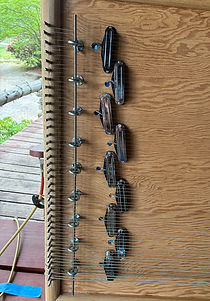
The fixed bridges On the Empath II are another set of threaded rods, in a straight line. These are raised up by eyelet bolts in the body of the instrument, similar to traditional string bridges. The string lengths on Empath II are varied across the instrument in two halves. These variations are created by the The lower 36 strings range from 32 inches to 31 inches, around the length of a bass guitar. The high
The fixed bridges Empath I are harp bridge pins in a cascading string lengths. These shorter strings allow higher pitches using all the same light (0.009") gauge strings. Empath I was designed in a flexible diatonic or chromatic string tuning scenario, allowing the player to tune to a full scale in multiple octaves (from about 60Hz to 440Hz).
String Lengths, Gauges, and Tension
Empath I's harp bridge pins have a consistent length of 24 inches for the lower 12 strings, while the higher 12 strings cascade from 23 down to 14 inches. You could say they range from the length of a small guitar down to slightly shorter than a violin. These shorter strings allow higher pitches using all the same light (0.009") gauge strings. Empath I was designed in a flexible diatonic or chromatic string tuning scenario, allowing the player to tune to a full scale in multiple octaves (from about 60Hz to 440Hz). The high strings do not resonate as much from the actuators, but they do add a shining glow of higher harmonics and metallic timbre.
Empath II has a similar scenario with the lower 36 strings being almost the same length and the higher ones cascading shorter and shorter. However, the low strings on Empath II do ramp slightly from 32 inches to 31 inches. The higher 36 strings cascade from 30 inches down to 22 inches. So, you could say it ranges in length from an electric bass down to a short scale guitar. It's pitch range is the same, from a low 30Hz, just lower than a 5 string bass, to an 330Hz identical to the highest string on a guitar. The Empath II has its straight bridges on the fixed bridge (pickup) side, and varies the lengths with the angle of the empath bridges.
Empath I has the convenience of guitar tuners for quick tuning and accuracy, but needed specialized geometry, routing the strings around the harp bridge pins. The Empath II eliminated this complexity by angling the empath bridges but the tradeoff is using zither tuners. These zither tuners are cheap and much easier to mount, allowing the strings to be closer together, but they take more effort to get in tune and more time. Still, they hold their tuning just fine and allowed me to fit as many strings as there are in twelve guitars over nine pickups.
When it comes to gauges and tension, these instruments balance gauge, tension, and tuning in a similar way to traditional instruments, with one primary difference. This kind of string actuation requires much lower string tension than plucked or bowed string instruments. The sweet spot for string tension seems to be around 11-14 lbs. per string on the plain steel strings and 15-17 lbs. for each nickel-wound string. This is nearly half the string tension we use for electric guitars.