Ben Hjertmann
Music Composition, Teaching, Recording, Instrument Building
Jeff's Partch Adapted Guitar I
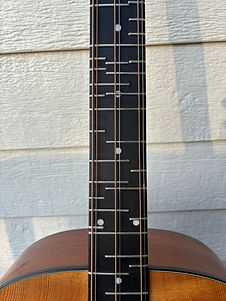
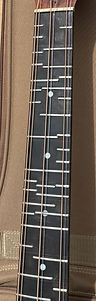
This guitar was commissioned by Jeffrey Gavett to perform Harry Partch's Barstow, December, 1942, and new works by myself and others. It is modeled exactly after Partch's very first Adapted Guitar I, but also includes additional frets added by John Schneider for his version, and a few more of my own. All pitches fit into the basic 29 of the 11-limit tonality diamond (27 of them) and of course into Partch's larger 43-tone tuning.
It is six strings arranged in three octave courses (see tuning docs below). Note that, like Partch's original, the lower-sounding string in each course is closer to the performer, which is the opposite of standard 12-string guitar arrangement. Furthermore, note that all three courses are octaves: no unisons as on the higher courses of a 12-string.

_edited.jpg)
Tuning of the Courses
In exploring the tuning above you will notice several interesting elements that distinguish this from a normal guitar.
All of the following is Partch's own design, that we kept identical.
The tuning of the courses is in JI Major thirds, 5:4 frequency ratio. This means that the courses are tuned slightly closer together than the normal strings on a guitar, even a bit closer than the standard G and B strings, since 5:4 is 14% smaller than a 12EDO major third.
Since there are two major thirds, the open chord is an augmented triad (16:20:25), an unusual open sonority.
The two sets of two courses are the same interval apart, it adds consistency to the two-course interval shapes.
While it might be conceptually simpler to have, say, a major triad as the open chord, it would not be easier to play. If it were tuned that way, barring across all three courses would be the way to play major triads and it would becoming very tiring. Instead having the augmented chord as the open tuning allows more comfortable shapes in the left hand. The major triad is like frets 5, 5, 4 (in 12EDO fret-speak) and the minor triad is 5, 4, 4. This is much more friendly to the players hand and stamina.
The pitches themselves are Eb (+14c), G, and B (-14c) so that the middle course is tuned to Partch's universal tonic. I guess he figured that if he was gonna have 43 pitches to the octave, the least he could do was not change key...
As you'll see from the fret ratios in the chart above, the fret locations themselves are sometimes more complex than the sounding pitch ratios because they counteract the string tuning to get the desired pitch. For example, the 15/11 fret on the lowest course allows the pitch 12/11 by multiplying by 5 (going up a major third) to counteract the fact that the lowest course is tuned to the pitch 8/5. There is no 15/11 pitch in Partch's 43tone tuning, but a fret located a 15/11 interval above the open string is needed to get the 12/11 pitch.
This creates some complexity for the instrument designer and luthier, but if they signed up for this project, they're probably down for a challenge. It means that more fretlets are needed and less straight frets, which makes it more complex to build and possibly to play, but the reward is that only a limited set up pitches are present on all courses, despite the tuning of the courses. If one were to put full frets at all these locations, not only would finger space be reduced, but a bunch of non-Partch-43 pitches would pop up as well.
The same limited-pitch set is true for the Lou Harrison Nek Chand Resonator guitar. It only has 12 total pitches, with fretlets used wherever needed to counteract the string tunings.
Guitar Modification Details
It was a pleasure to get to convert this Taylor 114, check out the wavy grain on the spruce top!
In order to guide the strings into courses while keeping the saddle and bridge the same, I needed to adjust the nut, saddle, and headstock.
Brass Guide Rods before Saddle
I installed put brass rods in the bridge, before the saddle (the bone/synthetic piece that functions as the bridge).
Thanks to John Schneider, Chris Rainier, and their respective luthiers for this idea!
This model allows strings I and VI to remain in their normal positions. Strings V and II are pushed toward strings I and VI to make them into courses. Strings II and IV are pushed closer together to make a course in the center.
The exact spacing of these rods and the strings themselves in the courses was one of the most difficult parts of this build. These are spaced about 3mm apart, ever so slightly wider than a modern 12-strings' (2.5mm). The slightest 1/3 of a mm too far or too close did not work would feel wrong or rattle.

The Nut and Headstock String Guides
The nut had to match the string spacing at the saddle exactly. Since the strings fan out slightly down the neck, this was also very tricky. We decided to adapt the original nut. You can see the former string slots in it.
I also put brass rods in the headstock to keep strings II and V off of the tuners for strings I and VI.
